Evidence note: Scripture's condemnation of child sacrifice and Christ's welcome of children are explicit. Applying these truths to institutional medical policy is an ethical argument that must be made without equating every medical refusal with ancient ritual sacrifice. Explore the historical and cultural context.
What Watch Tower teaches
Watch Tower publications condemn child abuse and child sacrifice and describe refusal of prohibited blood as faithfulness to God's law. This study does not question the sincerity of parents who acted under that teaching. It asks whether the medical prohibition itself is actually commanded by Scripture and how Christian authority should respond when an interpretation places a child's life at grave risk.
Begin with the whole passage
Read: Deuteronomy 12:29–31 ; 18:9–14 ; Psalm 82:1–4 ; Jeremiah 7:21–34 ; Ezekiel 34:1–24 ; Mark 9:33–37 ; 10:13–16
The Law condemns offering sons and daughters in fire and calls the practice detestable. Jeremiah says such acts did not come from Yahweh's command or heart. Israel's leaders are judged for failing to protect the weak. Jesus receives children, places them among his disciples, warns against causing little ones to stumble, and rebukes those who try to keep them away.
- verse within paragraph
- paragraph within chapter
- chapter within book
- book within the whole of Scripture
Ask the Holy Spirit, who inspired the written Word and is the Spirit of Truth, to illumine what He gave. Illumination receives the text faithfully; it does not bypass its grammar, context, or place in the whole counsel of God.
Biblical authority moves toward the vulnerable with truth, protection, and care.
Scripture judges leaders by whether they reflect God's character toward people with the least power.
Read in context: Psalm 82:1–4 ; Jeremiah 7:21–34 ; Ezekiel 34:1–24 ; Mark 9:33–42 ; 10:13–16 ; John 10:7–18
Hear the passage in its first world
Language, customs, institutions, geography, and the beliefs of the ancient world can help us notice what the first hearers likely understood. Background serves the passage. It may clarify the text, but it may not override the wording or manufacture a meaning the passage does not support.
Children had limited social power in the first-century world
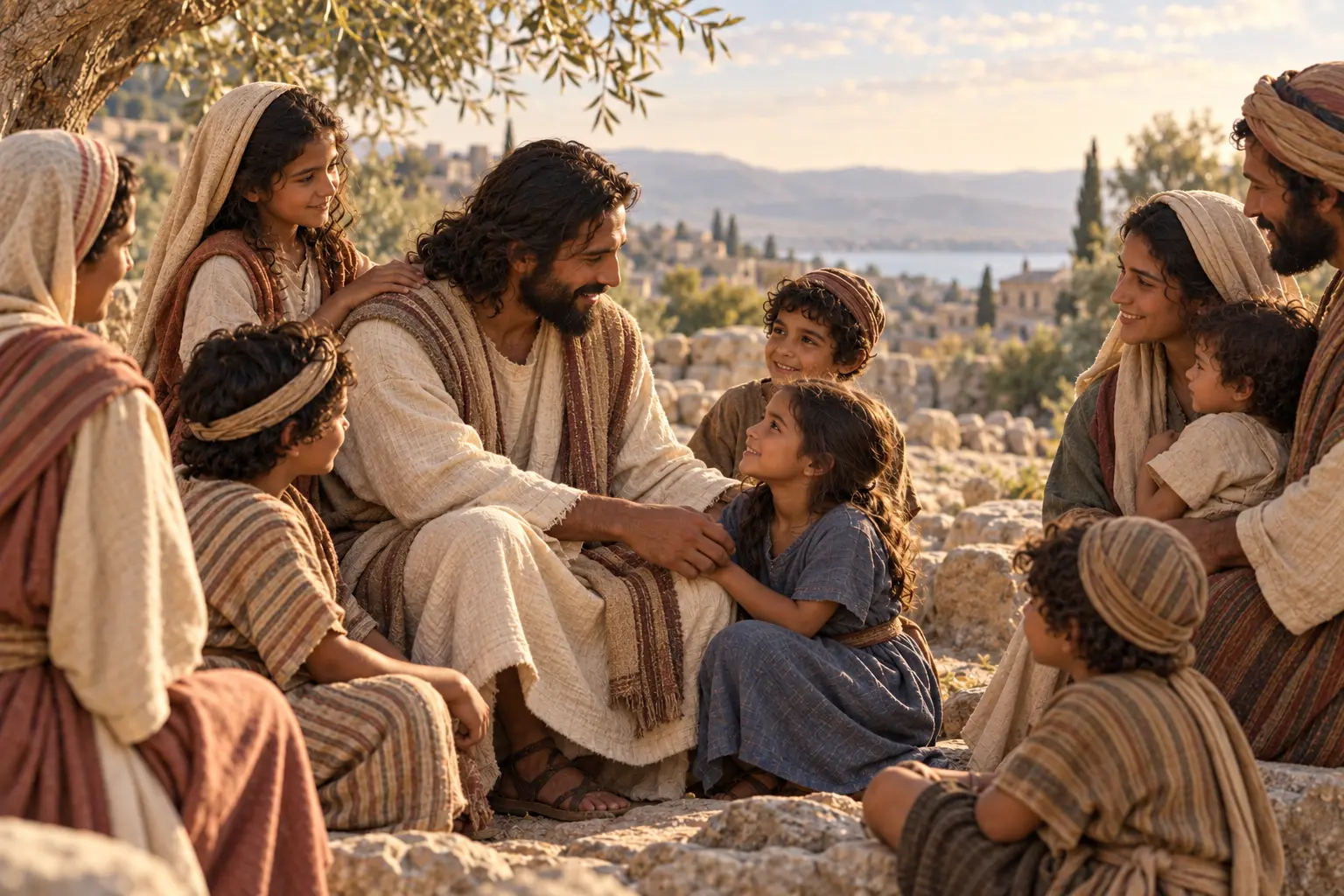
Children were loved within families, yet they possessed little public status or legal power. Jesus' decision to place a child among disciples who were debating greatness and to receive children whom others tried to exclude reverses ordinary status calculations.
Why this matters: Jesus does more than display affection. He makes welcome, protection, humility, and dependence visible through people with little social leverage.
- Mark 9:33–42 ; 10:13–16 Children within Jesus' teaching on greatness, welcome, and the Kingdom
- Craig S. Keener, The IVP Bible Background Commentary: New Testament Social background for children and household life
Prophets judge shepherds by what happens to the vulnerable
Biblical shepherd language is political and pastoral. Ezekiel condemns leaders who feed themselves while failing to strengthen the weak, heal the sick, bind the injured, or seek the lost. Yahweh promises to rescue the flock and raise up his Davidic shepherd.
Why this matters: Religious authority is measured not only by claimed intention but by truthfulness, protection, care, and accountability before God.
- Jeremiah 23:1–8 ; Ezekiel 34:1–31 ; John 10:1–18 False shepherds, Yahweh's rescue, and the Good Shepherd
- Daniel I. Block, The Book of Ezekiel, Chapters 25–48NICOT historical and exegetical commentary
Evidence guardrail: Well documented means the evidence is direct and broadly established. Strong contextual support means the explanation fits substantial evidence but remains an argument. Debated background means responsible scholars differ or the reconstruction depends on later or incomplete evidence.
Where interpretation begins
These passages do not supply a complete modern medical protocol. They do establish God's character and the moral burden carried by religious leaders. A life-endangering rule requires unusually clear biblical warrant, careful handling of medical facts, freedom from coercion, and honest accountability for the rule's consequences. Appeals to obedience cannot make an institutional inference equal to God's command.
An insight worth considering
Parents facing an emergency may be loving, frightened, and sincerely trying to obey God. The pastoral task is not to shame them. It is to remove a burden God has not imposed, restore moral agency, and show from Scripture that protecting a child is not spiritual betrayal.
This section presents a reasoned ministry insight. It is offered for testing by Scripture, context, logic, and relevant evidence. It is not labeled as an explicit sentence of the biblical text.
Follow the reasoning
- Yahweh explicitly condemns child sacrifice and separates it from his own will and character.
- Biblical leaders are accountable for whether their teaching protects or devours the flock.
- Jesus places children near the center of his kingdom teaching and receives them with tenderness.
- No organization may convert a disputed application into the voice of God without carrying the full burden of proof.
- Medical decisions must be made with qualified clinicians, accurate information, informed consent, and attention to the specific patient.
- Compassion requires care for families who have experienced loss, not the use of their suffering as a debating instrument.
Why this matters for knowing and following Christ
Jesus does not treat children as expendable demonstrations of adult loyalty. He receives them, blesses them, identifies himself with welcoming them, and gives his own life for his sheep. His authority is protective, truthful, and self-giving.
Questions to consider
For conversation, choose the question most appropriate for the person and consider one question at a time. For personal preparation, you can copy the complete set.
- What does Jeremiah say about whether child sacrifice came from Yahweh's command or heart?
- How does Jesus respond when others try to keep children away from him?
- What burden of proof should apply when a religious interpretation may result in irreversible harm?
- How can Christians care for families without shaming people who acted under fear and sincere belief?
Open-text conversation prompts
Choose one question, read the complete passage together, and make room for an honest answer. These prompts are invitations to examine the text, not scripts for cornering a person.
- If a medical prohibition is not explicitly stated in Scripture, who bears responsibility for proving that the inference is strong enough to risk a child's life?
- How do Jesus' welcome of children and his warnings to shepherds shape the way religious authority should operate?
- Can questioning a human interpretation be an act of faithfulness to God rather than rebellion against him?
Continue without losing the path.
The sources below broaden the topic. Their inclusion does not imply agreement with every conclusion. Each Research Library entry identifies the author's relevant qualification, perspective, and an important caution.
- Leviticus 1–16Jacob Milgrom
- The Death and Resurrection of the Beloved SonJon D. Levenson
- Child Sacrifice in Ancient IsraelHeath D. Dewrell
Scripture, scholarship, and primary sources
- Jeremiah 7 with translators' notes NET Bible
- Mark 10 with translators' notes NET Bible
- Religious and Ethical Position on Medical Therapy Official Watch Tower clinical summary; verify its current date and policy language
- Heath D. Dewrell, Child Sacrifice in Ancient IsraelHistorical and archaeological study
- John N. Oswalt, The Book of Isaiah, Chapters 1–39NICOT commentary on divine justice and care for the vulnerable
Source links are provided for verification. An external source documents its own text or position; linking does not endorse every claim on that site.